Firebird SQL中索引对INSERT、UPDATE和DELETE性能的负面影响
一般来说,索引对于任何严肃的数据库都是必需的,因为它们对于加速带有 WHERE 子句的查询(SELECT、UPDATE、MERGE、DELETE 等)至关重要。然而,每个索引都有其代价,当我们比较在带索引和不带索引的字段上执行 INSERT/UPDATE/DELETE 操作的速度时,这种代价就显而易见了。
在本文中,我们将演示带有几个唯一键的索引对操作速度的影响。
测试数据库
让我们创建一个简单的 Firebird 数据库:
CREATE DATABASE “E:\TESTFIREBIRDINDEX.FDB” USER “SYSDBA” PASSWORD “masterkey”;
CREATE TABLE TABLEIND1 (
    I1            INTEGER NOT NULL PRIMARY KEY,
    NAME          VARCHAR(250),
    MANORWOMAN  SMALLINT
);
CREATE GENERATOR G1;
SET TERM ^ ;

create or alter procedure INS1MLN
returns (
    INSERTED_CNT integer)
as
BEGIN
inserted_cnt = 0;
WHILE (inserted_cnt <1000000) DO
BEGIN
 Insert into tableind1(i1, name, manorwoman) values(gen_id(g1,1), 'TEST name', (:inserted_cnt - (:inserted_cnt/2)*2));
 inserted_cnt=inserted_cnt+1;
END
suspend;
END^
SET TERM ; ^
GRANT INSERT ON TABLEIND1 TO PROCEDURE INS1MLN;
GRANT EXECUTE ON PROCEDURE INS1MLN TO SYSDBA;
COMMIT;
为了演示不良索引带来的问题,让我们执行以下操作:
- 首先,向表中插入 100 万条记录
- 然后更新这些记录
- 之后,删除所有记录
- 最后,运行 SELECT count(*) from the table
下面的命令执行上述操作:
set stat on;  /*enable display of statistics in isql*/
select * from ins1mln;
update tableind1 SET MANORWOMAN  = 3;
delete from tableind1;
select count(*) from tableind1;
让我们运行它并保留结果以供进一步分析。
之后,让我们创建另一个具有相同结构的表–并为 MANORWOMAN 列添加索引
CREATE INDEX TABLEIND1_IDX1 ON TABLEIND1 (MANORWOMAN);正如你在上面的脚本中所见,我们只向此列插入 0 或 1 的整数值。这样的索引对于 select 查询是无用的,理论上,所有数据库开发人员都应该避免这种不良索引(除了表中值分布不平衡的特殊情况),但在实践中,有许多索引只有 2 个唯一值,甚至只有 1 个。
然后让我们使用此索引重复脚本并比较结果–参见下表:
| 不带 MANORWOMAN 索引 | 带 MANORWOMAN 索引 |
| SQL> set stat on; /*show statistics*/ SQL > select * from ins1mln; INSERTED_CNT ============ 1000000 Current memory = 10487216 Delta memory = 80560 Max memory = 12569996 Elapsed time= 13.33 sec Buffers = 2048 Reads = 0 Writes 18756 Fetches = 7833503 SQL > update tableind1 SET MANORWOMAN = 3; Current memory = 76551788 Delta memory = 66064572 Max memory = 111442520 Elapsed time= 15.04 sec Buffers = 2048 Reads = 16166 Writes 15852 Fetches = 6032307 SQL> delete from tableind1; Current memory = 76550240 Delta memory = -1548 Max memory = 111442520 Elapsed time= 3.27 sec Buffers = 2048 Reads = 16147 Writes 16006 Fetches = 5032277 SQL> select count(*) from tableind1; COUNT ============ 0 Current memory = 76552064 Delta memory = 1824 Max memory = 111442520 Elapsed time= 1.35 sec Buffers = 2048 Reads = 16021 Writes 1791 Fetches = 2032278 |
SQL> set stat on; /*show statistics*/ SQL> select * from ins1mln; INSERTED_CNT ============ 1000000 Current memory = 10484140 Delta memory = 75524 Max memory = 12569996 Elapsed time= 23.94 sec Buffers = 2048 Reads = 1 Writes 23942 Fetches = 11459599 SQL> update tableind1 SET MANORWOMAN = 3; Current memory = 76548712 Delta memory = 66064572 Max memory = 111439444 Elapsed time= 29.30 sec Buffers = 2048 Reads = 16167 Writes 19492 Fetches = 10035948 SQL> delete from tableind1; Current memory = 76547164 Delta memory = -1548 Max memory = 111439444 Elapsed time= 3.41 sec Buffers = 2048 Reads = 16147 Writes 15967 Fetches = 5032277 SQL> select count(*) from tableind1; COUNT ============ 0 Current memory = 76548988 Delta memory = 1824 Max memory = 111439444 Elapsed time= 0.69 sec Buffers = 2048 Reads = 16021 Writes 1901 Fetches = 2032278 |
因此,不良索引在插入或更新时会使性能降低大约 2 倍。此外,我们还可以看到,非最优索引大大增加了写入次数和记录读取次数。
让我们获取此示例数据库(带有 MANORWOMAN 的不良索引)的统计信息,并尝试找到一些细节。为了收集统计信息,我们运行以下命令:
gstat -r e:\testfirebirdindex.fdb > e:\teststat.txtTABLEIND1 表和索引统计部分看起来很有趣,但它给了我们什么有用的信息呢?
TABLEIND1 (128)
    Primary pointer page: 166, Index root page: 167
    Average record length: 0.00, total records: 1000000
    Average version length: 27.00, total versions: 1000000, max versions: 1
    Data pages: 16130, data page slots: 16130, average fill: 93%
    Fill distribution:
       0 - 19% = 1
      20 - 39% = 0
      40 - 59% = 0
      60 - 79% = 0
      80 - 99% = 16129

    Index RDB$PRIMARY1 (0)
      Depth: 3, leaf buckets: 1463, nodes: 1000000
      Average data length: 1.00, total dup: 0, max dup: 0
      Fill distribution:
           0 - 19% = 0
          20 - 39% = 0
          40 - 59% = 0
          60 - 79% = 1
          80 - 99% = 1462

    Index TABLEIND1_IDX1 (1)
      Depth: 3, leaf buckets: 2873, nodes: 2000000
      Average data length: 0.00, total dup: 1999997, max dup: 999999
      Fill distribution:
           0 - 19% = 0
          20 - 39% = 1
          40 - 59% = 1056
          60 - 79% = 0
          80 - 99% = 1816
为了理解所显示数字和百分比值的含义,我们可以使用 HQbird Database Analyst,它提供了数据库统计信息的可视化解释:
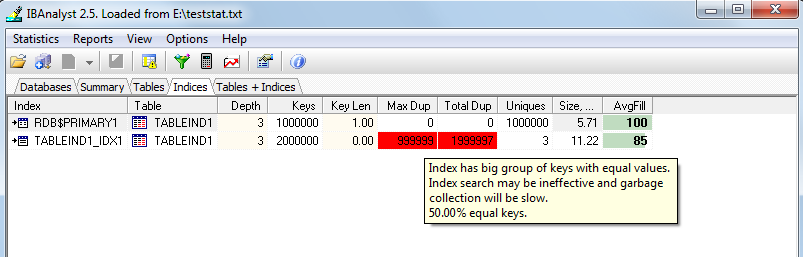
通过点击 Reports/View recommendations,我们可以找到针对此索引的适当解释:
Bad indices count: 1. By `bad` we name indices with many duplicate keys (90% of all keys) and big groups of equal keys (30% of all keys). Big groups of equal keys slowdown garbage collection - MaxEquals here is % of max groups of keys having equal values. Index search for such an index is not efficient. You can drop such indices (if they are not on FK constraints).
Index ( Relation) Duplicates MaxEquals TABLEIND1.IDX1 (TABLEIND1) : 100%, 50%
在生产数据库中,我们经常可以看到许多不良索引,它们会极大地影响数据库性能。在这个例子中,我们可以看到一张拥有 1300 万条记录的表,其中有 7 个不良索引,这些索引(很可能)是无用的,并且大大降低了 Firebird 的性能:
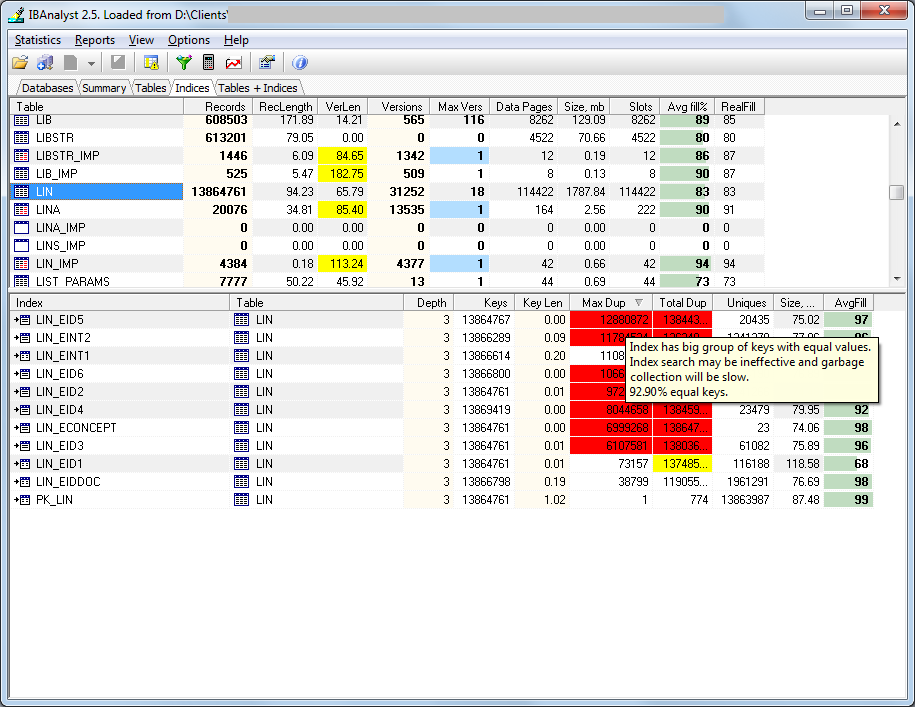
如果 HQbird Database Analyst 将索引标记为「Useless」(即它们只有 1 个值),则建议在可能的情况下立即删除这些索引。
如果索引被标记为 Bad(其中有几个值),也应考虑删除,但要谨慎:有可能不良索引被用于某个特定的 SQL 查询中,该查询需要特定的索引组合(包括不良索引)才能快速运行。
当然,这些 SQL 查询应该被重写,以使用没有不良索引的更优执行计划。为了找到此类查询,应该进行 SQL 计划审计:最简单的方法是使用 HQbird PerfMon 运行跟踪会话并启用 SQL 计划日志记录,然后搜索特定不良索引的 SQL 计划。